Showing posts with label Eric Warmoth. Show all posts

Monday, February 20, 2017

Trump's Repeat of "Law and Order"

President Nixon's disapproval of how Chief Justice Earl Warren was running his court. After the case of Miranda v. Arizona, Nixon argued that the Supreme Court was defending criminals and that he could bring order and stability. His goal was to appeal to the "forgotten Americans" and gain the white middle-class voters' support in the election.
Image result for nixon rally
Today, experts argue that Trump's campaign attempted to do the same thing. The opening night of the Republican National Convention's theme was "Make Our Country Safe Again." While crime in 1968 was through the roof, it's at a historic low today. But despite this, Trump aspired to play to the unrest surrounding social and cultural change. He talks about issues such as taxes, Islamic terrorism, and diversification of America, all of which worry a certain group of the American population.

Trump has said that he does not hope to unify the American people, just as Nixon did, but rather gather enough middle-class support that feels anxiety about the current situation in America. Whether they're worried about police brutality, attacks on the police, or a variety of different issues, Trump hopes to offer a shift in leadership and opportunity for change.


Image result for trump rally
Like Nixon, Trump rode this support to the Presidency and followed up on his claims. While Nixon's foreign policy attempted to end the War in Vietnam, Trump followed through with his Muslim ban and order to construct a wall on the border of Mexico.

Sources:
http://www.politico.com/magazine/story/2016/07/donald-trump-law-and-order-richard-nixon-crime-race-214066
http://www.huffingtonpost.com/entry/donald-trump-richard-nixon-rnc_us_578cda12e4b0fa896c3f2b2e
https://www.nixonlibrary.gov/thelife/apolitician/thepresident/

Sunday, February 19, 2017

Laika - First Animal in Orbit

Between 1948 and 1951, both the Americans and the Soviet Union attempted to send animals into space, but they never reached orbit and many of them perished. The US sent a monkey, Albert II, up 83 miles into space, but after surviving the flight he died on impact. In 1950, the US also sent a mouse to study its behavior with weightlessness, but that also died. Finally, the US sent an anesthetized monkey, Yorick, up to space with 11 mice. Yorick survived the flight but died after the landing still inside the space capsule, and 9 mice survived. 

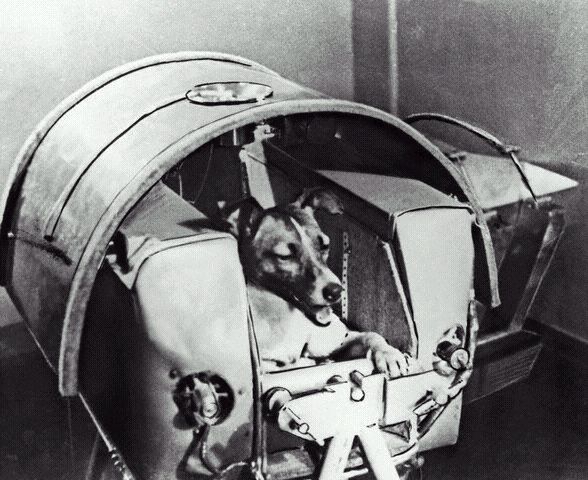
6 years after these tests, Sputnik II launched into orbit. It carried a dog originally named Kudryvaka, called Laika by the American people. Though Laika didn't survive, she greatly scared the United States given the superiority of the current Soviet space program. After launching the first Sputnik into orbit before the Americans could launch something, and effectively beginning the space race, Americans began fearing the power of the Soviets. They were worried that if the Soviets could send animals up into space, eventually they could send bombs to be dropped on basically any city in the United States. 

Image result for laika ethics animal testing
One source of controversy was the fact that no preparations were made to attempt to bring Laika back alive. Originally, no news was spread to the world of the outcome of Laika, and people were curious whether she would be returning. The National Canine Defence League and England's Royal Society for the Prevention of Cruelty to Animals began to make their voices heard and call out the Soviet space program for their use of animals in testing. Eight days after Laika officially died, the Soviets confirmed her death. Laika's cause of death was a mystery for a long time, and not until 2002 was it confirmed that Laika died before 7 hours had passed due to heat and stressed.

Sources:
http://www.history.com/news/ask-history/what-was-the-first-animal-in-space
http://www.ecolinc.vic.edu.au/sites/default/files/pages/Lesson_7_Ethics_of_Animal_Research_Teracher_Notes.pdf

Sunday, February 5, 2017

Operation Pied Piper

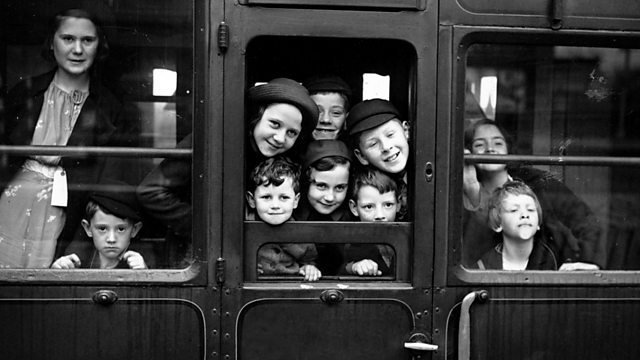
In the first four days of September 1939, almost 3 million people were moved from the cities to the rural countryside, in fear of bomb raids. A majority of the evacuees were schoolchildren, who were separated from their families and homes and brought through a traumatic experience of separation. 

Given predictions of 4 million civilian casualties in London, parents hurriedly wanted their children to be evacuated and sent to the safety of the countryside, but the kids did not have a say in the matter and often had no idea where they were headed or why. 

Even 60 years after, people who experienced the evacuation still recall what it was like and how it made them feel. The government propaganda caused mass hysteria because it vastly overestimated the casualties and portrayed death. And though planned efficiently, the actual execution of the operation was arguably more traumatic than the evacuation.

Because they were being taken to the countryside, children often arrived in places that were already full or were no longer offering their homes to children anymore. In addition, many children arrived in the wrong locations, furthering the issue of insufficient housing arrangements. 

One of the most famous lines still remembered today is “I’ll take that one.” In places where the number of children outnumbered the available homes, they would have the homeowners come and pick which kids they would allow to stay in their homes. This caused great trauma for the kids that weren’t picked, as they felt like they would not have anywhere to stay or were not liked by anyone. 


But not all experiences were bad, there are tales of children who stayed in the homes of families who welcomed them as one of their own or wealthy families who had servants that cared for them. While people who lived like this remember their time fondly, there are still countless others who lived in families who did not care for them or actually abused them, who will remember that forever as a scarring experience.

Today, James Roffey maintains the “Evacuees Reunion Association”, which he founded in 1996 to create a magazine that is sent out to all members of the association that tells stories of childhood memories and organizes events for people who went through various evacuation programs as children.


Establishment of the CIA


After World War 2 and the abolishment of the Office of Strategic Services (OSS), President Truman signed the Neutrality Security Act of 1947 which established the CIA. Given the success of its precursor, the OSS, the CIA was tasked with coordinating the nation’s intelligence activities and collecting and distributing intelligence regarding national security. The goal was to create an agency that would be independent of the political branches of the government, and would thus be solely focused on protecting America. 

Image result for cia cold war
The Central Intelligence Agency Act was passed in 1949, which expanded the powers of the CIA. The main importance of this legislation was that the CIA’s budget could maintain secrecy for covert operation funding by allowing transfer of money from other departments without restrictions. 

Furthermore, in 1953 the National Security Act was passed, which added a Deputy Director of Central Intelligence to the leadership of the CIA to back up the pre-existing Director of Central Intelligence. This new position would be appointed by the President and would assist the Director as second in command. 

As the Cold War ramped up, the CIA became an important source of American Intelligence. In 1955, the CIA Headquarters were built in Langley, Virginia (where they still are today) after being given 46 million dollars by President Eisenhower in 1955. 
In 1962, the CIA was involved in the infamous Cuban Missile Crisis. After supporting the invasion of Cuba by backing and arming Cuban exiles, the CIA discovered that Cuba was negotiating with the Soviets. After further investigation, they found the Soviet missiles pointed at the US, creating the entire crisis that was a huge development in the Cold War because it represented an actual threat quite close to home that spooked the country. Without the CIA’s intelligence, this discovery could have possibly come after some sort of offensive by the Cubans, thus creating a much bigger event than the reality of what happened.


Sunday, January 29, 2017

The Tehran Conference


In 1943, a meeting took place between FDR, Churchill, and Stalin in Tehran, Iran. These three discussed the end of the war and plans for post-war and how to handle the world’s delicate state. One of their most important discussions was that of Operation Overlord, the plan for Britain and the US to invade Northern France and begin to move in on Germany. Stalin agreed to help them by continuing his efforts on the eastern front to keep the Germans fighting and splitting their attention. In addition, Roosevelt and Stalin made a deal that Stalin would declare war on Japan following the defeat of Germany, and Roosevelt would give Stalin land in northern China. These proceedings were confirmed by all sides, but not finalized until the Yalta Conference in 1945.


One of Stalin’s most important issues at this conference was the fate of Eastern Europe. He desired it to become under Russian control as he had gone through liberating most of these countries with that expectation in mind. It was decided that Eastern Poland would become part of the Soviet Union, Poland’s borders would be expanded into Germany, and the Baltic States would hold a referendum to decide their fate of joining the Soviet Union or not. The three leaders also decided to split post-war Germany up into allied zones for them to each control a part of.

Just like Wilson had his goals of the League of Nations, Roosevelt had hopes of instituting an organization to keep world peace and prevent another world war. He brought up the United Nations to Stalin, saying that US, Britain, China, and the Soviet Union would be the main four in control and the ultimate peacekeepers with the ability to deal with any emergency situation. 
At the end of the conference, the world leaders left Tehran feeling confident. Unlike the peace negotiations after World War 1, each of them felt like they made significant gains. For the US, Roosevelt felt like he gained Stalin’s trust by dealing with him directly and also received promise of Russia’s back up in the war in the Pacific. For Britain, they received guarantee of inclusion in the post-war negotiations and a powerful position in the UN, in addition to confirmation of the long-awaited help in the war against Nazi-Germany. For the Soviet Union, Stalin made important gains towards his goal of making Eastern Europe under his control, and he started to lay the groundwork for the future expansion of the Soviet Union.

Source:

Native Americans in World War 2

Even despite the horrible treatment they received throughout history by the American government, Native Americans participated in the army for World War 2. They understood what it meant to fight for their land, and thus strove to help the US, their home too. Many tribes sent a decent percent of their population or even all of their able-bodied males to enlist to fight in the war.

The Germans feared the Native Americans because their language was so unknown to the Nazis. During the 1930s, agents posing as anthropologists tried to infiltrate Native American tribes and learn some of their language for further advantages. But coming up to World War 2, Germany did not expect them to join the army, as Propaganda Minister Josef Goebbels believed the Swastika was similar to a sacred symbol. Quite the opposite happened because the Native Americans believed that they would be enslaved by the Nazis and lose even more liberty.


In addition to the 80,000 natives that went to fight in the war, about 40,000 who stayed at home found jobs helping the war efforts. Because the Native Americans had only really stayed on their reservations before, this movement to the general workforce represented a unification of ideas behind a common goal, winning the war. In addition, many tribes purchased Treasury Stamps and Bonds and donated to the Red Cross in hopes of further helping the US and its organizations fund the war effort.

World War 2 also increased women’s roles within the reservations. Because so many men were off fighting, women generally got to work in roles generally suited for men and gained vital skills for advancing their social roles.

In addition to the Germans not being able to understand the language of the natives, neither could the Japanese. The navy recruited Navajo Native Americans to relay messages, and “The Navajo Code Talkers” were a highly recognized radio unit that specialized in transmitting some of the most important messages. After their first use in 1942 on Guadalcanal, over 400 Navajo became code talkers crucial to the Pacific ocean and the war against Japan.
Image result for navajo code breakers ww2
Navajo Code Talkers
Representing one of the first ways for Native Americans to make a decent living, the war increased the quality of life across the board for natives living on reservations. By 1944, the average annual income was $2,400 higher than it was in 1940 before the war started. Native Americans were fully recognized for one of the first times, and this greatly aided them in their fight for equal rights in American to come.

Source:

Sunday, January 22, 2017

The FBI during World War II

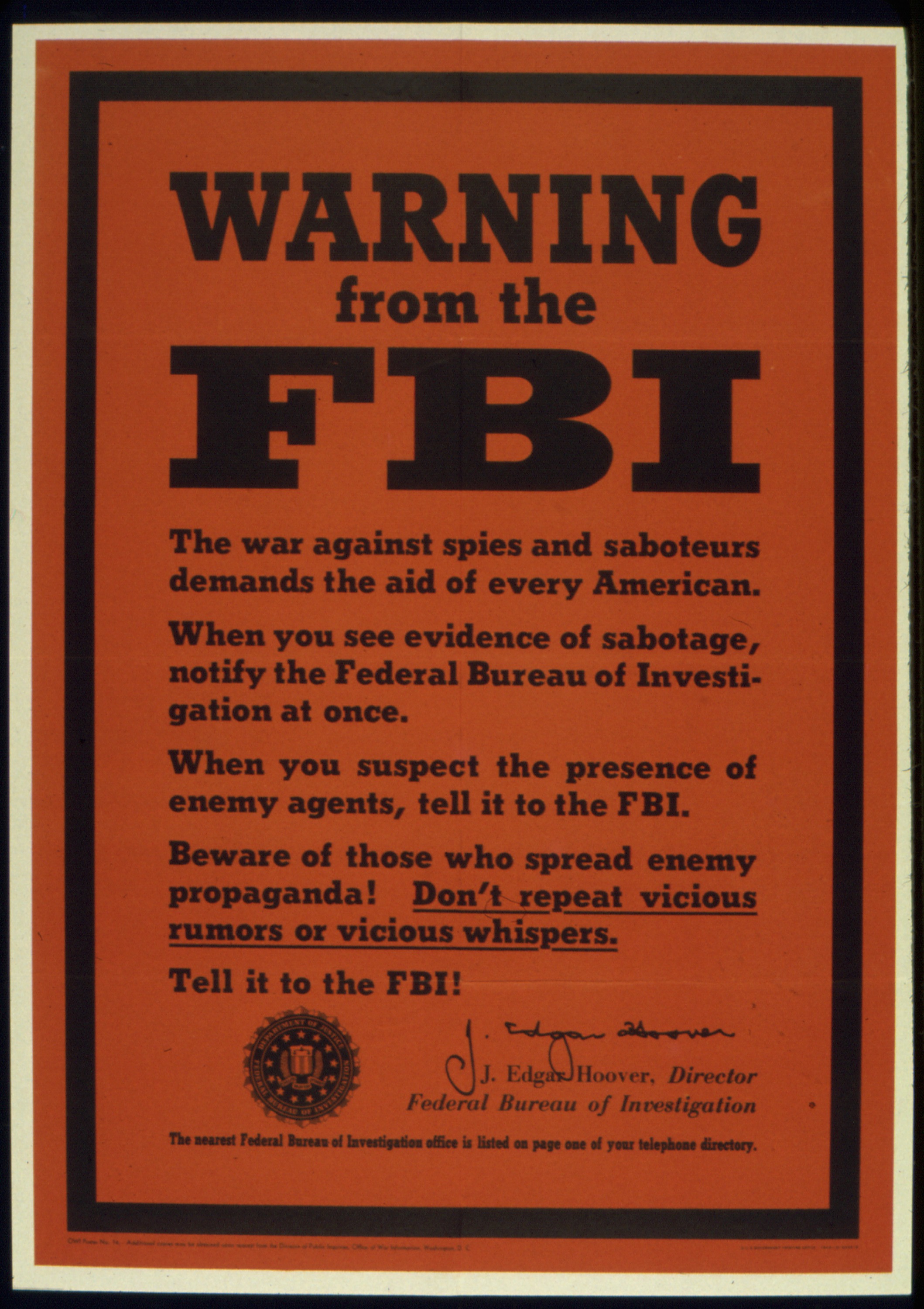
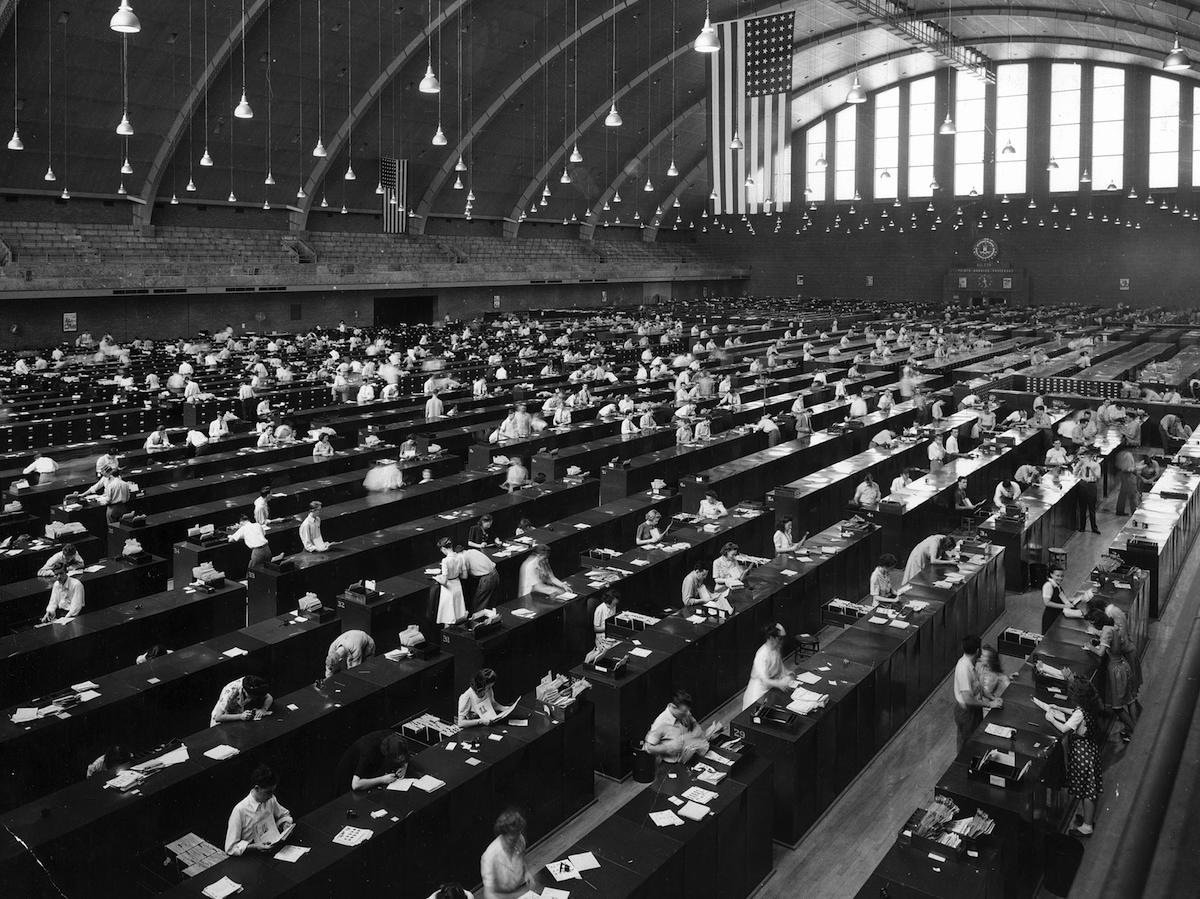
In 1936, President Roosevelt made a Presidential Directive that further strengthened the FBI's authority throughout the US, further enforced by the Smith Act of 1940 which outlawed advocacy of violent overthrow of the government. Then in 1939 when the US entered the war, the FBI's responsibilities greatly escalated. The FBI began developing a vast network of informational sources, who they used to investigate potential threats to national security based on various reports.

When Congress established the draft in late 1940, the FBI was responsible for tracking down evaders and dissenters of the draft. Then in June 1941, when the Germans attacked Russia, the FBI focused internal security efforts on potentially dangerous Germans, Italians, and Japanese. In addition to this, the FBI collected intelligence throughout the US. The FBI's staff cooperated with various other professions in order to allowthe US to sometimes control the flow of information from the belligerents in the Western Hemisphere, giving them a huge advantage.
                                                 Image result for fbi world war 2
Another important duty of the FBI during the war was sabotage investigations. After Operation Pastorius, the German sabotage attempt on American soil, and the susccessful investigation by the FBI leading to the capture of the eight men sent by Germany, the American people truly trusted the agency tasked with protecting them.

Following the bombing of Peral Harbor, FBI Headquarters and the 54 field offices were placed on 24-hour schedules and many previously identified aliens were arrested in the following days as threats to national security. The total number of FBI employees rose from 7,400 to over 13,000 by the end of 1943.
                                  Image result for fbi world war 2


Despite all the concern over the war, the FBI maintained a solid amount of civil rights investigations, including segregation. Additionally, the FBI had one contingent of agents, the SIS, in charge of monitoring and destroying any Axis activities in South America.  Another aspect of the FBI that was not related to the war effort was the FBI Disaster Squad, who identified various disasters such as a plane crash involving FBA agents.

By establishing  precedents for the limits of the FBI, the war greatly expanded the power of the FBI and transformed the organization permanently. The increase in employees and various powers granted to them during the war effort both allowed the FBI to evolve beyond what it had ever been before, and much of the basis of today's FBI can be credited to this time.

Source:
https://www2.fbi.gov/libref/historic/history/worldwar.htm

Operation Pastorius

Operation Pastorius was a failed German operation hoping to sabotage the United States war effort during World War II. This operation was headed by Admiral Wilhelm Canaris, chief of the German Abwehr. The Abwehr was a German military intelligence program existing within the German defense ministry between 1920 and 1945. Following the bombing of Pearl Harbor and Germany's declaration of war on the United States, Hitler authorized this mission in hopes of repeating a World War I plan that was successful against the French in Morocco.

Eight German residents who had lived in the United States were recruited. Two of them were American citizens, while the others had simply worked in the US. These agents went through an intensive sabotage training program and were instructed on the use of bombs and other skills necessary to perform their roles. Their mission was to stage attacks on important American economic stations. This included hydroelectric plants, the Aluminum country of America's plants, locks on the Ohio river, and a crucial railroad. Their other goal was to spread terror throughout the country by blowing up bridges, railroad stations, or public places.
Image result for operation pastorius agents
The Eight German Agents
When the first four agents landed on US soil, led by George Dasch. Landing at Amagansett, New York, the team buried their explosives and gear on the beach. Dasch was discovered by an unarmed Coast Guardsman, John C. Cullen, who he threatened and tried to pay off with $260. Cullen then returned to his station and reported this encounter, allowing a patrol team to search the beach. Though the Germans had already left, the patrol found their buried equipment and reported it to both the FBI and President Roosevelt. The other four members landed without any problems at Ponte Vedra Beach, Florida.

After realizing that their plan was not secret anymore and the FBI were surely on their trail, Dasch began to question his loyalty to the Nazis. He called up another member to his hotel room, and they both agreed that ultimately they hated the Nazi party and everything that it stood for, given the other member's time imprisoned in a Nazi concentration camp. They agreed at the end of the night to defect to the United States immediately and go to the FBI.

Initially, Dasch attempted to call the FBI from a payphone, but the agent receiving his call figured the man was crazy. Four days later, he went to Washington D.C. and went to the FBI's headquarters himself. Going from office to office getting dismissed by various agents as crazy, he finally ended up in the office of Assistant Director D.M. Ladd, who was in charge of the hunt for the Germans who landed on the beach in New York. Not until Dasch placed his mission budget of $84,000 did Ladd finally believe him. The rest of the spies were arrested in the next two weeks.

Roosevelt issued Executive Proclamation 2561, creating a military tribunal to try the arrested Germans. All eight were sentenced to death, but Roosevelt commuted Burger's sentence to life in prison and Dasch's to 30 years for turning themselves in.

Because this plan failed, it deterred Hitler from making any future attempt at sabotaging the United States. There was only one other time that Germans were even dispatched on submarines to the US coast, and both men sent were captured by the FBI.


Sources:
http://www.dailymail.co.uk/news/article-1372973/Revealed-The-secret-Nazi-operation-Pastorius-land-German-soldiers-U-S-soil-sabotage-war-effort-world-war-two.html
http://militaryhistory.about.com/od/socialeffectsofwar/p/pastorius.htm

Saturday, December 3, 2016

Death of Marion Zioncheck

Marion Zioncheck, A Democrat in the House of Representatives, was killed after falling, whether pushed or jumped, out of a window in Seattle in 1936. A note was found in his office where he fell from, reading "My only hope in life was to improve the condition of an unfair economic system that held no promise to those that all the wealth of a decent chance to survive let alone live."
Image result for marion zioncheck news article


His death was ruled a suicide. Because Zioncheck had decided not to run for a 3rd term and had been described as depressed by colleagues, people suspected he was done with life feeling like he had nothing left. He was a hardcore supporter of the New Deal, and given frustration and bizarre behavior regarding his policies it was easy for investigators to look past the potential of murder. But family members disagreed, and they believed he had been pushed. Additionally, a current Seattle police captain who is familiar with the case does not believe it was a suicide. While Zioncheck's brother in law, William Nadeau, had told the police at the time that he walked up to the office and actually saw Zioncheck jump out and tried to grab him as he did. The police captain, Neil Low, currently occupies the office that Zioncheck occupied in 1936. This was the cause for his further investigation, and along with others, he holds the opinion that Nadeau's story has flaws such as the amount of detail given despite it being a traumatic event for Nadeau.


Zioncheck's successor, his friend who Zioncheck had offered his seat too in his retirement, was the King County prosecutor, Warren Magnuson. But what was not widely known was that the building that Zioncheck fell from was his campaign headquarters for the election of that year. Magnuson went on to be elected to the Senate and arguably one of Washington's most influential politicians ever.


Source:
http://www.seattlepi.com/local/article/Suicide-or-murder-75th-anniversary-of-pol-s-1740520.php
http://www.historylink.org/File/5528

Thursday, December 1, 2016

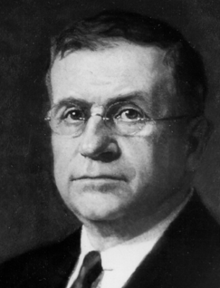
Harold L. Ickes and the New Deal

Harold L. Ickes was a U.S. socialist born in Pennsylvania in 1874. In 1933, he was appointed the 32nd Secretary of the Interior by President Roosevelt. He became a figure in the New Deal administration that would make lots of headway in terms of reform.


Ickes.gifFor his early life, Ickes worked in a settlement house and took civil liberties cases as a lawyer for free, believing he was doing the right thing. Given his care for social reform, he often flipped between the two major political parties, Republicans and Democrats, and was eventually the perfect choice for President Roosevelt when he was looking for a progressive Republican for his cabinet. Once he became the Secretary of the Interior, Ickes was very prominent in his New Deal support as he fought to preserve natural resources from private companies who wanted to use them for their personal advantages.

One of the major programs of the New Deal, the PWA, was headed by Ickes. It was in charge of any environmental programs created by the federal government. He was very conservative in the creation of projects and spending, and though his programs were often slow to get rolling, they rarely contained flaws in their designs due to the precision of Ickes. One of his crowning achievements was the creation of "yardsticks". These services were for electric power-rates through power projects of both the national and state level governments.

In comparison to today's election, Harold L. Ickes for President Roosevelt was much like Elizabeth Warren for Presidential Candidate Hillary Clinton. While differences exist, such as Warren only being a senator from Massachusetts and defending a candidate running from their first term, while Ickes was a member of incumbent President Roosevelt's cabinet during the elections, there are more similarities. Ickes was considered "Roosevelt's hatchet man" by many, as he constantly attacked the Republican candidates throughout Roosevelt's elections. Just like Ickes, Elizabeth Warren has constantly taken to twitter to write strong messages that promote anti-Donald Trump sentiment. She has been a prominent figure in the media due to the popularity that her tweets gained for being so abrasive against Trump.

After President Roosevelt was assassinated, Ickes was kept in the cabinet by President Truman. But just one year after President Truman took office, Ickes resigned from his position due to controversy surrounding his testimony in the Senate confirmation hearing of Edwin W. Pauley for the Secretary of the Navy. He felt that President Truman was pressuring him to lie on the stand for the sake of the party and to get Pauley confirmed easily.

Source: https://www.britannica.com/biography/Harold-L-Ickes

Wednesday, November 30, 2016

Recovery emphasized by the New Deal

Recovery was emphasized by the New Deal because of the Hundred Days Congress legislation, as well as many New Deal programs that were created after that. Most of the agencies created had the goal of recovery. Not only were these agencies made to help the public in specific areas, but they also supplied jobs for many people as officials had to be hired for all of the new organizations. 

Since one of the main goals of FDR's administration and the Hundred Day Congress was ending unemployment, many of the New Deal programs greatly assisted this goal by providing jobs not only in government agencies but in also other lines of work. One program that provided jobs for the common man was the WPA, or the Works Progress Administration. Its main goals were conservation and general public services. Workers employed by this administration fixed roads, railroads, and often did work concerning conservation. 8.5 million people were employed by this legislation, thus making it one of the strongest forces of recovery during and after the Great Depression.

Additionally, the New Deal helped the farmers recover from the economic hardship they faced in the mid 1920s and leading into the 1930s. Given the surpluses of food and livestock farmers had, their prices would be very low and they would often make very little money off their products. During this time, farmers would often dump food to diminish their supply so that their prices could be raised, even though people were starving in the city not being able to pay for the food once the prices were raised by the farmers. The AAA, Agricultural Adjustment Act, was legislation passed that was focused on reducing agricultural production. The government would pay farmers to not plant on certain plots of land, kill off livestock, and even bought cows from farmers and gave them cans of meat in return to feed themselves. This recovery greatly helped the field of agriculture attempt to rebalance its economy which would help the overall economy in general.

Saturday, November 26, 2016

Supreme Court Adapting to the New Deal


Image result for supreme court under roosevelt

At the beginning of Franklin D. Roosevelt's second term, the Supreme Court was filled with nine older ultraconservative judges who ruled against many New Deal programs. Because of the recent victories in Congress and with his Presidency, Roosevelt believed that the people supported the New Deal program and thus the Supreme Court should fall in line. Since they wouldn't, he proposed the Judicial Procedures Reform Bill, which became known as the Court-packing plan, in 1937, which would allow him to add a new liberal justice to the court for every justice older than 70 who wouldn't retire. This was highly criticized by the public due to the implications that Roosevelt was tampering with the system of checks and balances.

As most assume is due to the public's support of the New Deal, Supreme Court Justice Owen J. Roberts switched his opinion on the New Deal. After the case of West Coast Hotel vs. Parrish in 1937, where minimum wage laws were deemed constitutional, the Supreme Court ruled in favor of all future New Deal programs. Given this decision coming around the same time as Roosevelt's proposition of his court-packing plan, many believed he had succumbed to the pressure of politics and public opinion given his complete reversal on all New Deal policy. While in reality Justice Roberts' vote was cast before Roosevelt announced his plan, this did not change the perception of him in the public eye as most began to view the Supreme Court as willing to flip on their core beliefs. The fact that Justice Roberts had found a similar state minimum wage for New York unconstitutional did not help his case much because his rulings in the two cases conflicted with each other.
While this change in opinions benefited Roosevelt's New Deal programs, he was able to make 9 nominations and fill 8 out of the 9 Supreme Court seats with Democratic justices that he nominated during his 12 years in office. But even with more liberal justices of his choosing, fewer New Deal reforms were passed after 1937 due to the political capital Roosevelt lost during the controversy of his court-packing plan.

Hugo Black, Stanley Forman Reed, Felix Frankfurter, William O. Douglas, Frank Murphy, James F. Byrnes, Harlan F. Stone, Robert H. Jackson, and Wiley Blount Rutledge were all appointed by Roosevelt. Wiley Blount Rutledge was the replacement for James F. Byrnes since he retired in 1942, still during Roosevelt's presidency. The one justice not replaced during Roosevelt's presidency was Harlan Stone, who was nominated to the Supreme Court by Calvin Coolidge and promoted to Chief Justice by Roosevelt.


Sources:
https://www.britannica.com/biography/Owen-Josephus-Roberts
http://supreme-court-justices.insidegov.com/d/d/Franklin-D.-Roosevelt
http://www.fjc.gov/servlet/nGetInfo?jid=2299&cid=0&ctype=sc&instate=na&highlight=null

Saturday, November 19, 2016

Bureau of the Budget

As we read at the end of Chapter 34, "American Life in the Roaring Twenties", the Bureau of the Budget was created in 1921 by the Republican Congress and President Harding, which passed the Budget and Accounting Act. It's purpose was to help the President with his submission of an annual budget to Congress in order to prevent extravagant expenses. This act was the first formal legislation that placed restrictions on how the government could spend its money. In 1971, the Bureau of the Budget became the Office of Management and Budget, the framework of our modern federal budget system.

Additionally, some members of Congress in 1974 had issues with their current budgetary system in place. Due to President Nixon's threat of impoundment, a process of withholding Congressional appropriations that did not agree with his own policies, leading to the beginning of the Congressional Budget and Impoundment Control Act of 1974. This act strengthened Congressional oversight of the budget because it enabled a way for Congress to create and enforce its own budgetary ideas without necessity of the President. The House and Senate Budget Committees were also created for oversight of the budget process and the Congressional Budget Office was created to inform Congress and its committees with information regarding current economic issues. The Congressional Budget Office has had nine Directors since it's founding in February of 1975.

By the time the Bureau of the Budget was in place and functioning, President Coolidge was in office and was thus the first President to have control over the budget. With appropriation requests and expenditures coming in from executive agencies, Coolidge was the one controlling the budget and thus had the ability to confirm or deny the requests. With this ability, this legislation just provided for a further expansion of presidential power during the 20th century that helped coordinate the modern system. Today, the Office of Management and Budget produces the President's Budget and measures the quality of various programs, policies, and procedures to verify them with the president's policies and make sure they line up.
Image result for office of management and budget
The current staff of the Office of Management and Budget

Source:
https://www.cbo.gov/about/history
http://lcweb2.loc.gov:8081/ammem/amrlhtml/dtbudact.html
http://www.worldhistory.biz/modern-history/80988-budget-and-accounting-act-1921.html

Sunday, October 16, 2016

The Pullman Strike

Founder and President of the Pullman Palace Car Company,  George Pullman organized his company in 1867. Early on in his company, he decided to create a city to house all of his workers. Anyone who wanted to work for him was required to live in this three-thousand-acre city. Because he controlled everything in his city, the workers were subject to his decisions on wages, rents, prices, and everything in between.

In 1893, Pullman decreased the wages 25% due to a depression, but he kept the rent prices the same. Because of this, the expenses of the workers stayed the same but their incomes were not sufficient to support them. When many workers went into debt due to this change, Pullman took the money they owed him out of their paychecks, perpetuating the issue of money.

Then, on May 11, 1894, a "wildcat" strike erupted in Pullman City. Three thousand workers went on a strike without authorization of their union, which was the American Railroad Union for most. Then in June, some of these Union members barred trains with Pullman cars to move, besides the mail cars.

When a group of 24 railroads, the General Managers Association, tried to end the strike, and said they would fire anyone who did not move cars. The union then countered that threat, saying that if someone was fired for this, all union members would walk away from the job. When the end of June came, fifty thousand men quit, fights broke out, and the railroads were barren of movement west of Chicago.

The calling of federal troops required permission from President Cleveland, but at this time, he was not willing to send them without consent of the Governor. John Altgeld did not want to agree to sending federal troops to stop the strikes because he believed in workers rights and equality to the rights of their bosses.

Attorney General Richard Olney was on the side of the General Managers Association, and he favored President Cleveland sending troops into Chicago to end the strike. When Olney received an injunction from a federal court labeling these strikes illegal, Cleveland had to send in troops to end the strike, and violence broke out in the streets as the angry cries of the people that the federal government was intervening were heard.

The ringleader of the union workers, Eugene Debs, was arrested along with several other union leaders. After this, he realized his efforts were useless with the federal troops present, and so most workers went back to work. Several were blacklisted, meaning no railroad could ever hire them.

The importance of the Pullman Strike was that it helped people realize how bad employers could really be. No longer was George Pullman a figure of hope for factory workers, but people saw him as greedy and someone who treated his workers poorly.

This strike, one of the 4 major strikes during this time period, which alongside the Great Railroad Strikes of 1877, the Haymarket Square Strike, and the Homestead Steel Strike, helped people notice workers rights and the importance that individuals had to the industrial system.


Source: http://www.lib.niu.edu/1994/ihy941208.html

Sunday, October 9, 2016

Why made the Gilded Age "Gilded"?


The Gilded Age, named by Mark Twain in 1873, was the late 19th century. This phrase means that from the outside, everything looked perfectly normal and great, but what people couldn't see was the corruption. The famous "Robber Barons" that we have begun learning about were a staple of the time, as shady business practices and scandalous politic decisions took place.


Aspects of this time period that were sparkling, included the creation of a modern industrial economy. Corporations ruled business and transportation and communication were innovated. Additionally, many reforms fought against corruption like the Civil Service Act and the Sherman Antitrust Act.

This time also led to the Populist Party, which represented the interests of farmers who were burdened by debt, who wished the government would help the farmers, reduce tariffs, and introduce an income tax.

But despite these seemingly positive traits of the time, events like the forced movement of the Plains Indians onto reservations and anti-immigrant reactions. Additionally, politics went through tough times as disputes rattled the scene. Labor relations, currency, tariffs, patronage, and railroads were all highly debated between political parties as each had their own intentions. One example of one such dispute, was that over tariffs. In the election of 1888, the Republicans made tariffs their issue, and thus Benjamin Harrison won the elections because the tariff was lowered by the Congress during the presidency of President Cleveland.

Ultimately, this era contained men looking out for themselves, as America was reshaped after the Civil War into more of what it is today. Corruption and greed plagued many men high up in the federal government and corporations that were very influential over society and how everyday life went.Image result for the gilded era


Source:
http://www.digitalhistory.uh.edu/era.cfm?eraid=9

Sunday, October 2, 2016

McClernand - Brave or Selfish?

John Alexander McClernand 
When I was reading Civil War Chapter 8, Stalemate East and West, I found Major General McClernand's story very interesting. He was a prominent War Democrat from Illinois before the war, he was favored by the administration when Lincoln and Stanton heard his plan of attack for a victory in the Misissippi. While he had top secret orders for this plan, Lincoln made an escape clause which allowed Halleck and Grant to take command of the entire operation, including his troops, if they wished to.

With early successes in battles like Fort Henry, Fort Donelson, and Shiloh, McClernand found himself praised by the press and others began to despise his self-promotion and envious nature. One example of this, was William Sherman, who felt that Mclernand cared too much about the glory of battle than dealing a blow to the Confederates, and another example is Mclernand's clash with the West Pointers due to his dislike of graduates from the U.S. Military Academy.

The issues between McClernand and Grant started when McClernand was instructed to send the troops he was raising in Illinois down to Vicksburg, where they were being brought into Grant's forces without McClernand knowing. When he came down to join the fighting in Vicksburg as well, he was surprised to find out he would no longer be independently commanding the troops he worked so hard to gather, but he would be under the command of Grant. These tensions continued throughout the attack on Vicksburg.

When the frontal assault on Vicksburg failed, McClernand once again praised himself and his own troops on the front lines, but when Grant send for reinforcements, the disaster grew. With Grant feeling that McClernand was "entirely unfit", McClernand wrote to the newspapers with praises for his men and criticisms for Grant, which was a brech of military protocol. After this, Grant relieved him of command. A few months later, due to his favor in Washington, McClernand was restored to his old command, but he was forced to resign eventually due to illness.


Source

Thursday, August 25, 2016

Why does the American form of Government work?

Federalist Essay No. 10: 


Quote 1: "By a faction, I understand a number of citizens, whether amounting to a majority or a minority of the whole, who are united and actuated by some common impulse of passion, or of interest, adversed to the rights of other citizens, or to the permanent and aggregate interests of the community."


Quote 2: "No man is allowed to be a judge in his own cause, because his interest would certainly bias his judgment, and, not improbably, corrupt his integrity. With equal, nay with greater reason, a body of men are unfit to be both judges and parties at the same time; yet what are many of the most important acts of legislation, but so many judicial determinations, not indeed concerning the rights of single persons, but concerning the rights of large bodies of citizens? And what are the different classes of legislators but advocates and parties to the causes which they determine? Is a law proposed concerning private debts? It is a question to which the creditors are parties on one side and the debtors on the other. Justice ought to hold the balance between them. Yet the parties are, and must be, themselves the judges; and the most numerous party, or, in other words, the most powerful faction must be expected to prevail."


Response: As represented by these quotes, the new system of government in America was successful because the American citizens are united behind a common cause. Not only were they united behind the American Revolution, but they're behind the common interest of individual rights for each citizen and their country as a whole. Additionally, the American government realized certain issued that had to be determined for success as a nation, such as establishing a difference between judges and parties, legislators and advocates, and these determinations help with the order and beginning stages of the American government.


Federalist Essay No. 51:


Quote 1: In order to lay a due foundation for that separate and distinct exercise of the different powers of government, which to a certain extent is admitted on all hands to be essential to the preservation of liberty, it is evident that each department should have a will of its own; and consequently should be so constituted that the members of each should have as little agency as possible in the appointment of the members of the others. 


Quote 2: But it is not possible to give to each department an equal power of self-defense. In republican government, the legislative authority necessarily predominates. The remedy for this inconveniency is to divide the legislature into different branches; and to render them, by different modes of election and different principles of action, as little connected with each other as the nature of their common functions and their common dependence on the society will admit. It may even be necessary to guard against dangerous encroachments by still further precautions. As the weight of the legislative authority requires that it should be thus divided, the weakness of the executive may require, on the other hand, that it should be fortified.


Response:: In the 1st quote, the American government is displayed as the beginning of separation of powers. The essay lays out the fact that there should be different powers of government, each with different roles, and that they should not remain connected in how each is appointed. The 2nd quote details the system of checks and balances, in which it says that since things need to be balanced, and each branch has different powers starting off, the checks have to be in varying defense levels. For example in legislation it is split into 2 houses with different connections, and is thus divided. On the other hand, the executive branch has to be fortified to keep it balanced.