Showing posts with label Iris Mang. Show all posts

Saturday, March 25, 2017

Title IX and Women's Sports

Today, equal participation in sports is almost a universal part of American life. Before Title IX of the Education Amendments was passed, schools did not offer equal academic and athletic opportunities for men and women, as people thought that men's sports were more popular and more profitable. As the feminist movement developed, people sought for changes in schools, where gender inequality is reflected in the athletic opportunities offered to male and female students.

In 1970, congresswoman Edith Green and senator Birch Bayh came up with the idea of Title IX in congressional hearings on equal rights for women. As the bill made its way through congress, it was kept from the public in order to minimize congress. Title IX was signed by Richard Nixon. It required equal access for women in all facets of education, especially athletics: "No person in the United States shall, on the basis of sex, be excluded from participation in, be denied the benefits of, or be subjected to discrimination under any education program or activity receiving Federal financial assistance."

The full impact of Title IX became clear in 1975 when the government made rules that gave colleges and universities three years to comply with the gender equality provision of the act. The law made a far reaching impact on women's athletics. In 1974, fewer than 300,000 girls played high school sports, while there are 3.1 million girls playing today.

An event that soon followed the passing of Title IX was Battle of the Sexes, where Riggs, a former male tennis champion, challenged Billie Jean King, a famous female tennis player. The match was attended by more than 30,000. King defeated Riggs, and this became a symbol for the feminist movement. The match helped legitimize women's athletics and encouraged girls to take up sports. Title IX expanded much more opportunities for female athletes, and today, we can still see its impact.


Saturday, March 18, 2017

Gloria Steinem


Image result for gloria steinem the playboy

Gloria Steinem was born on March 25, 1934 in Toledo, Ohio, where she lived with her parents. When she was 11, her parents divorced an she had to take care of her mentally ill mother alone. She went to Smith College, where she studied government, a subject that not many women would study at that time.

Steinem did not want to follow the common path for women, which was marriage and motherhood. After graduating from college, she received a fellowship to study in India. She started her career as a freelance writer. In 1963, she wrote a famous article called "A Bunny's Tale" for the Show magazine about the Playboy Club, which became very famous. She went undercover as a waitress. Her article exposed that the waitresses were overworked and underpaid.

She struggled with her career, because she found that it was hard to be assigned serious political news stories because of sex, so she created her own job by helping to create New York magazine. She became engaged in the women's movement and reported about an abortion hearing. She attended rallies, protests, and sit-ins. She gave lectures and became a public image for the women's movement.

Along with other feminists, she formed the National Women's Political Caucus, with supported the changes in the Equal Rights Amendment and other issues. Steinem since co-founded a number of organizations that focus on human rights issues. She also authored four books. Today, she is still working to support equality.


Source:
http://www.biography.com/people/gloria-steinem-9493491
https://www.nwhm.org/education-resources/biography/biographies/gloria-steinem/

Friday, March 17, 2017

California's Aerospace Industry

The main reason that California became the sixth largest economy in the world was because of the aerospace industry. Around the mid 20th century, the was a boom in the aerospace industry in Southern California as large companies moved to the cheap land. As a result, employment boosted and California's economy developed rapidly.

World War II created many big businesses and lead to new technology in the aerospace industry. During this time, the aerospace industry cranked out numerous amounts of bombers and other military aircraft. Technology also developed as new innovations such as unmanned missiles came into use. Later, scientists and engineers developed the unmanned aircraft and guided missiles.

All of this was centered in Orange County. Low business taxes, a large labor pool, and Southern California's mild weather, which was ideal for flight-testing, attracted industry to the region. Big companies such as Douglas Aircraft, Lockheed, and North American Aviation established operations around LA.
Image result for california aerospace industry 1960

The cheap price of land was a big incentive for the businesses to move from elsewhere. For example, in 1957, a company called Hughes Aircraft Co. paid only $6 million for 426 acres of land in Fullerton.

The aerospace industry brought tens of thousands of jobs and allowed the economy to grow rapidly. In 1960, there were about 22,000 aerospace workers in Orange County. By 1970, there were 62,000 working there. This meant that employment almost tripled in 10 years. It supplied about 8.1% of all non-agricultural jobs in the county. Clearly, the aerospace industry was a factor that lead California to be the California we know today.


Source:
http://articles.latimes.com/1989-06-11/business/fi-3410_1_aerospace-industry-douglas-aircraft-huntington-beach

Sunday, March 12, 2017

President Johnson's Great Society


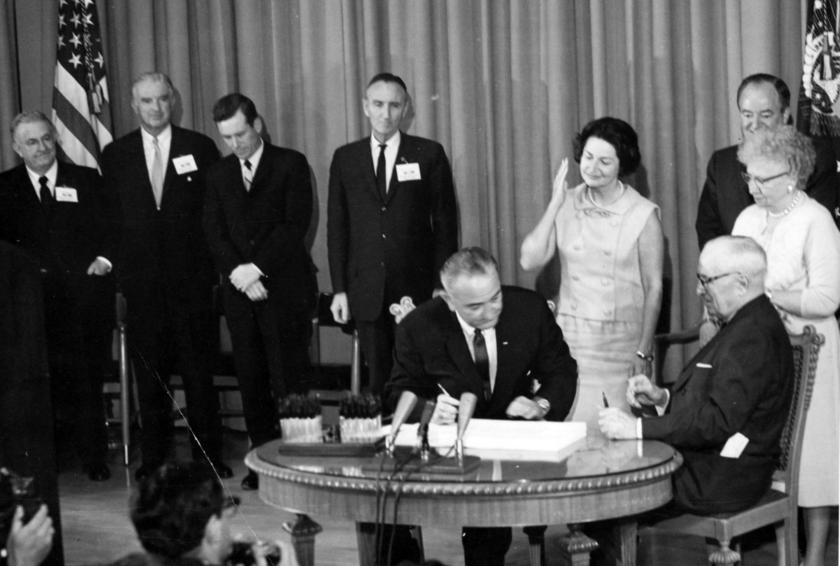
During his presidential term, President Johnson enacted nearly 200 pieces of legislature aimed to improve the everyday lives of Americans that he referred to as the Great Society. It was the largest reform since Franklin Roosevelt's New Deal. The programs under the Great Society were unprecedented and broad, and still have an impact on American society today.


Civil Rights
One of the most important legislatures passed was the Civil Rights Act of 1964, which was promised by Kennedy. This law banned discrimination based on race and gender in employment and ended segregation in all public facilities. Later, the Voting Rights Act of 1965 was passed that banned barriers from voting.

War on Poverty
The Opportunity Act of 1964 created the Office of Economic Opportunity that aimed to eliminate poverty. The Office of Economic Opportunity directed educational employment training programs.


Education
The Elementary and Secondary Education Act was signed in 1965 that committed the federal government to help local school districts whose students come from low-income families. The Head Start Program followed to give underprivileged children a "head start" before entering first grade. The Higher Education Act opened up opportunities for people to attend college through scholarships and low-income loans. 

Health
Medicaid and Medicare were set up, which were health insurance programs for elderly and low-income families. Today, many people still participate in this program.

Environment
The Air Quality Act and Water Quality Act gave the government more authority to control air pollution and water quality. The Wilderness Protection Act made 9.1 million acres of land federal wilderness areas.

Housing
The Omnibus Housing Bill provided subsides for low-income people who moved into new houses. 

Immigration
The Immigration Act of 1965 abolished discrimination based on national origins, so that some European countries were no longer given priorities. 

Sources:
http://www.washingtonpost.com/wp-srv/special/national/great-society-at-50/
http://www.ushistory.org/us/56e.asp

Saturday, March 4, 2017

The Birmingham Campaign

The Birmingham Campaign was one of the most important campaigns in the Civil Rights Movement. It was a local movement campaign at Birmingham, Alabama, one of the most segregated cities. It was joined and lead by Martin Luther King Jr and the Southern Christian Leadership Conference (SCLC) in April of 1963. The goal for the campaign was attack the city's segregation system.

The campaign started with mass meetings, lunch counter sin-ins, a march on the city hall, and a boycott of downtown merchants. King gave a speech to Birmingham's black citizens about nonviolent protest and gained a lot of support. The movement expanded to larger sit-ins and marches, such as sit-ins at the library and a march to the courthouse to register votes.

On the April 10, the city government responded with a state court injunction against the protests. The campaign leaders, however, decided to disobey the order. King knew that he faced the risk of going to jail, but he went on with the campaign. Two days after, he was arrested and jailed. It was there that he wrote "Letters from the Birmingham Jail". 

The campaign leaders thought that bringing children into action was a good idea to represent the young people's force. In May, more than a thousand students marched into downtown Birmingham. The local police used force to stop the demonstrations. The students were blasted by high-pressure water hosts, clubbed by officers, and bitten by dogs. Hundreds were arrested. This shocked and angered many Americans, who saw the brutal images on television and newspapers. 


Negotiations were finally set up between the black citizens and the city's businesses. When the campaigners agreed to halt their demonstration, the city announced the desegregation of public services, including lunch counters, restrooms, drinking fountains, and fitting rooms. The businesses agreed to hire blacks, and hundreds of protesters were released from jail.

This did not mean the victory of movement, as the city witnessed many bombings of Civil Rights leaders and desegregated places. The Birmingham campaign, however, made huge progress for the Civil Rights movement.

Sources:
http://kingencyclopedia.stanford.edu/encyclopedia/encyclopedia/enc_birmingham_campaign/
http://www.blackpast.org/aah/birmingham-campaign-1963

Monday, February 20, 2017

The Beat Generation


Image result for the beats
     The Beat Generation was a cultural and literary movement that happened in the 1950s. It started out as a group of friends in Columbia University who shared similar ideas, and later evolved into a movement. The Beats were never large in terms of numbers, however, their works reflected the society at the time, and influenced the nation. 

     The Beat Generation was a response to the change in the postwar age. As the society became more materialistic, people questioned the consumer culture. People saw capitalism as destructive to the human spirit and contributive toward social inequality. Another part of the movement was dissatisfaction toward the older generation, who saw discussions of sexuality as unhealthy. They challenged the clean formalism of the earlier writers, and embraced a bold, straightforward, and expressive style of writing. 
   
     The core group of the Beats were Jack Kerouac, Allen Ginsberg, Neal Cassady, and William S. Burroughs, who met in Columbia University. Many of their works became milestones in American literature, which are still studied today. For example, when Allen Ginsberg published Howl in 1956, people have never read anything like it. The poem explored the underside of America, including drugs and prostitution. Foul language and slang were used throughout his poem.

     The Beat Generation caused a great impact in American literature. Their works were criticized as inappropriate and attention-seeking. However, they were an important part of literary history. They redefined censorship and challenged the mainstream. In addition, they brought up important issues to the nation's consciousness, such as environmentalism. 


Sunday, February 19, 2017

Suburbs in the 1950s

Image result for suburbs 1950s


In the 1950s, American average household income rose, and technology such as automobiles and and infrastructure such as the highway allowed for easier transportation and increased efficiency. There was a rise of suburbs, which are neighborhoods that are on the outskirts of cities. The most noticeable character of suburbs is its conformity. The houses in these neighborhoods almost look exactly the same. In a postwar period where people sought for tranquility and peace, it is not hard to understand the demand for a life in the suburbs, where people were on the same grounds as their neighbors, and where people could focus on their families.

Several factors lead to the rise of suburbs. After the war, the automobile industry boomed once again, lead by Ford, General Motors, and Chrysler. The Interstate Highway Act authorized the construction of thousands of miles of roads that made living further from work easier. There was also the appeal of living beyond the noise, pollution, overcrowding, and disease.

The most prominent propellers of suburb construction was the Levitt family, who built the Levittown. They experienced a new way to built communities by using the division of labor. A house construction was divided into exactly 27 steps, like a manufacturing process, therefore, 27 different teams of workers were involved. The workers were specialized in their own "step".

The Levitts' houses were affordable and futuristic, with stoves and television sets included. The streets were also designed to minimize noise. There were sets of rules for the homeowners that made the entire neighborhood presentable, for example, "do not hang laundry outside homes."

Although the suburban development was a key part of the makeup of the modern settlement and a representation of the increasing standard of living of Americans, it was also criticized for several reasons. For example, the idea of conformity might be limiting personal expression. Race was another problem, as African Americans were excluded in many places. As suburbs continue to grow, a new definition of the American life began to form.

Image result for suburb 1950s

Sources:
http://www.ushistory.org/us/53b.asp
http://ushistoryscene.com/article/levittown/

Friday, February 3, 2017

The Freedom Train's Journey Across America


Between 1947 and 1949, the Freedom Train covered 37,160 miles and visited 48 states across the United States. It was a traveling exhibition of the great documents of American history. They were displayed to more than 3.5 million visitors across 326 cities and towns.
The Freedom Train
Lead by President Truman, the Freedom Train was "A campaign to sell America to Americans" during a time when the freedoms which this country were founded on were threatened by the Cold War, and a time when people were afraid that their freedom would be lost to the nuclear age and Soviet expansion. Truman hoped this campaign would enable Americans to rediscover their freedom. It was also aimed at making reconciliations with the sacrifices and human costs of war, by giving meaning and worth to those sacrifices.
Display of the Constitution
The train was pained red, white, and blue. Its seven cars were loaded with some of the most important documents and objects of American history. Among them were the Emancipation Proclamation and Gettysburg Address, a letter from Christopher Columbus, George Washington's original copy of the Constitution, and the Declaration of Independence. People waited for up to six hours to look at these with their own eyes.
Visitors
The Freedom Train proved to be more than just a symbol. When the city of Birmingham revealed that they planed for separate times for whites and blacks to visit the train, the operating organization of the train refused to stop at the city, demonstrating the importance of equal freedom for all. The Freedom Train showed American citizens how hard-earned their freedom was, and ensured them that the same freedom would be upheld in the future.


Sources:
http://www.freedomtrain.org/freedom-train-story-08-principles.htm
http://mashable.com/2015/07/04/usa-freedom-train/