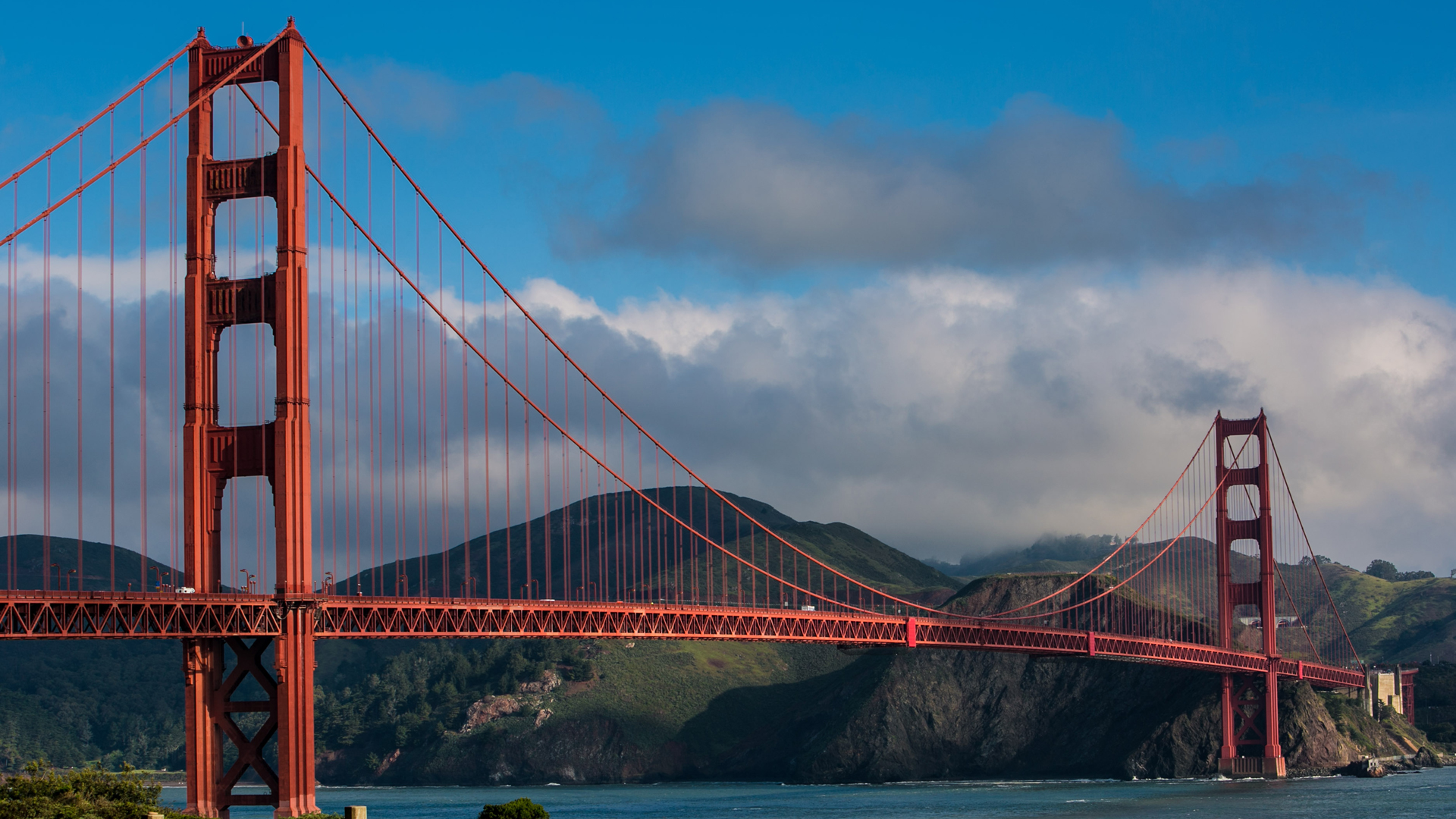
California's famous Golden Gate Bridge began being designed in 1919. Some people disapproved of its constructions becasue they thought that the bridge would disrupt the natural beauty of the bay and feared that it would not be able to withstand an earthquake like the one in 1906. However, this was addressed when the original suspension cable design was scrapped and a safer design was adopted. The construction of the bridge was difficult to initiate in the 1930s, as the Great Depression left many poor and made it hard to find a financial backer for the project. It was eventually given a major boost in funding by Bank of America. Construction spanned over four years and only resulted in one casualty. After its initial construction, the bridge was painted its classic "international orange" because the architect of the bridge thought the color complimented the landscape. Beside the grandeur of its structure and it being an iconic landmark for America, the Golden Gate Bridge has taken on more significance as time has passed: it has come to represent new beginnings, new opportunities, and a new life for those coming to the United States.
Sources:
http://www.history.com/topics/golden-gate-bridge
http://goldengatebridge.org/research/dates.php
Showing posts with label Allison Wang. Show all posts
Sunday, May 14, 2017
Wednesday, April 26, 2017
Saturday Night Live
Saturday Night Live first premiered on NBC in 1975. Started by Lorne Michaels, it is a sketch comedy show that explores a wide variety of themes and topics, from politics to global issues to everyday problems. The show originally did not have that great reception, but the network continued to hold onto it because executives believed that the spirit and the concept of the show were what people needed. Although SNL had a lot of trouble with writing, casting, and finding the line between funny and offensive, the show grew to be one of the largest, most well-known late-night television shows today.
While the main point of this show is comedy, the show has been known to shine a light on more serious topics and appeal to the audience by making jokes about them. For example, during the recent presidential election, SNL did many skits making fun of the candidates and the debates. Although their portrayal of the candidates was biased liberally, they still shared Trump's ideas and increased his coverage on television, which could have been a contribution to his election. Seeing these kinds of effects, it really is eye opening to see how, even today, television has a big role in politics and society. Even though SNL is primarily to make the audience laugh, it also brings attention to different important and imminent topics, showing the power of media today.
Sources:
https://en.wikipedia.org/wiki/Saturday_Night_Live#Development
http://variety.com/t/saturday-night-live/
Alec Baldwin and Kate McKinnon impersonating Donald Trump and Hillary Clinton, respectively
While the main point of this show is comedy, the show has been known to shine a light on more serious topics and appeal to the audience by making jokes about them. For example, during the recent presidential election, SNL did many skits making fun of the candidates and the debates. Although their portrayal of the candidates was biased liberally, they still shared Trump's ideas and increased his coverage on television, which could have been a contribution to his election. Seeing these kinds of effects, it really is eye opening to see how, even today, television has a big role in politics and society. Even though SNL is primarily to make the audience laugh, it also brings attention to different important and imminent topics, showing the power of media today.
Sources:
https://en.wikipedia.org/wiki/Saturday_Night_Live#Development
http://variety.com/t/saturday-night-live/
Monday, April 3, 2017
Tiananmen Square
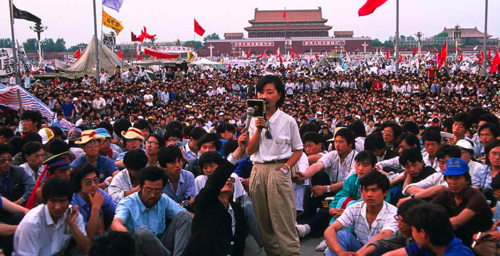
One story my father always tells me is about when he was a student protesting during the Tiananmen Square incident. The Tiananmen Square incident took place on June 3rd and 4th, 1989. In this event, the government cracked down on demonstrations taking place in Tianamen Square in Beijing, China. With the end of the eighties, new western, more liberal ideas were coming into the country. The economic growth of the time also allowed for price inflation and corruption in the government, driving people to want economic and political reform. Students were protesting in the square for individual rights and freedoms, surrounding a plaster statue named the "Goddess of Democracy." The protest in Tiananmen Square inspired protests in other cities in China, but the one in Beijing was the most publicized.
The government tolerated these protests for some time, but a shift in Chinese political leaders lead to the decision to attack the protestors. Martial law was declared on Beijing, and army troops dispersed the protesters using force in the forms of opening fire, arrests, and tanks. Dissenters were pursued for weeks after, and the government's response was highly criticized by other countries around the world.
The government's response to this incident was to downplay the incident; they antagonized the protesters and minimized the casualties of the crackdown. This denial of the severity of this incident occurs even today, which brings up the question: should the Chinese government acknowledge the severity of this event, or has the damage taken its toll?
Sources:
https://www.britannica.com/event/Tiananmen-Square-incident
http://www.history.com/this-day-in-history/tiananmen-square-massacre-takes-place
http://www.pbs.org/wgbh/pages/frontline/tankman/cron/
The government tolerated these protests for some time, but a shift in Chinese political leaders lead to the decision to attack the protestors. Martial law was declared on Beijing, and army troops dispersed the protesters using force in the forms of opening fire, arrests, and tanks. Dissenters were pursued for weeks after, and the government's response was highly criticized by other countries around the world.
Sources:
https://www.britannica.com/event/Tiananmen-Square-incident
http://www.history.com/this-day-in-history/tiananmen-square-massacre-takes-place
http://www.pbs.org/wgbh/pages/frontline/tankman/cron/
Saturday, March 25, 2017
Abortion in the 1960s
As we have talked about in class, abortions have been a controversial topic even before modern day. One offshoot of the Women's Liberation Movement of the sixties was the issue of abortion. Cases like Roe v. Wade allowed women to have more freedom and choices, but women still had to fight for their rights to control their bodies with things such as abortions and birth control pills. Some people believed that, with these new opportunities to control themselves and plan their families, women would have too much power and would disrupt the way of life that was already establish, where the husband was the breadwinner and the wife was the homemaker. Abortion was also antagonized for being immoral, as people argued that abortions killed babies and were not women's choice to do. This graphic imagery was associated with the Women's Liberation Movement (even though the Women's Liberation Movement wasn't about that idea) and painted it as an immoral, zealous campaign.
However, the Women's Liberation Movement aside, abortions were still pursued even when stigmatized. Those who needed one found ways to have it, even if it meant doing it in very unsafe, unsanitary, and in a lot of cases fatal methods. Abortions still happened even when the law forbade it; people will find a way to get what they need despite what society says. This brings up the question that we still argue about it today: If people get abortions, do we crack down on it more or legalize and regulate it? It's interesting to see how, almost fifty years later, we are still arguing about abortion. Will there ever be an agreement, or will we continue to fight against each other for centuries to come?
Sources:
http://www.cnn.com/2016/06/23/health/abortion-history-in-united-states/
http://www.ourbodiesourselves.org/health-info/u-s-abortion-history/
Sunday, March 19, 2017
Birth Control in the 1960s
As we have seen in class, birth control became available to women more easily in the sixties. This female contraceptive was fairly cheap (only about ten dollars a month), doctor-prescribed, and in the form of a pill taken every day. It was a major part of the sex revolution, for it allowed women to hold off on having children. However, the pill brought a lot of controversy with it. Let's examine the sides of the debate:
Pro: The pill allowed, for the first time, women to have real control of family planning. Because they were able to control their fertility, they could hold off having a family until later in life. They were able to focus on getting an education and developing their careers without worrying about taking care of kids. The birth control pill allowed, for the first time, women to take control of their lives and explore more outside the domestic sphere. Besides controlling fertility, the pill also allowed women with menstrual disorders to control their pain. Doctors would only actually prescribe the pill if the woman complained of menstrual disorders, not if she wanted to control her fertility. However, there was an odd coincidental spike in women with menstrual disorders during the sixties and, therefore, a lot of prescriptions for birth control pills.
Con: One facet of the argument against birth control was the morality of it. Some people believed that, because women could control when they were to have kids, the pill would promote more casual, reckless sexual activity and cause women to lose morality. As we saw in the documentary in class, some went even as far to relate the pill to "prostitution and abortion." Another aspect of this side of the argument was the health risk the pill presented: studies found that women over thirty-five that smoked (which was very common) and took the pill had a higher risk of things like heart attacks and blood clots.
This birth control pill debate brought a lot of double standards between genders to light. Why were men's contraceptives considered normal but women's contraceptives were seen as a violation of morals? Could this just have been a refusal to allow women to have more power, an attempt to keep women subordinate to men?
At least today, almost sixty years later, society has moved past this debate and allow women to take control of their bodies the way they want to and don't interfere with their decisions.
Right? :/
Sources:
http://ic.galegroup.com/ic/uhic/ReferenceDetailsPage/ReferenceDetailsWindow?zid=46b8ce3f64baefe999de168ca8fa2a6e&action=2&catId=&documentId=GALE%7CCX3468302420&userGroupName=gray02935&jsid=ad545500387bcc438c37a3283b01d2d7
http://www.pbs.org/wnet/need-to-know/health/a-brief-history-of-the-birth-control-pill/480/
https://s-media-cache-ak0.pinimg.com/564x/5f/82/28/5f8228780b4917e4c85c2ccaf1bee5c0.jpg
http://d35brb9zkkbdsd.cloudfront.net/wp-content/uploads/2012/03/birth-control-pills.jpg
http://www.jillstanek.com/wp/wp-content/uploads/2014/07/hobbylobbyprotest3.jpg
Con: One facet of the argument against birth control was the morality of it. Some people believed that, because women could control when they were to have kids, the pill would promote more casual, reckless sexual activity and cause women to lose morality. As we saw in the documentary in class, some went even as far to relate the pill to "prostitution and abortion." Another aspect of this side of the argument was the health risk the pill presented: studies found that women over thirty-five that smoked (which was very common) and took the pill had a higher risk of things like heart attacks and blood clots.
This birth control pill debate brought a lot of double standards between genders to light. Why were men's contraceptives considered normal but women's contraceptives were seen as a violation of morals? Could this just have been a refusal to allow women to have more power, an attempt to keep women subordinate to men?
At least today, almost sixty years later, society has moved past this debate and allow women to take control of their bodies the way they want to and don't interfere with their decisions.
Right? :/
Sources:
http://ic.galegroup.com/ic/uhic/ReferenceDetailsPage/ReferenceDetailsWindow?zid=46b8ce3f64baefe999de168ca8fa2a6e&action=2&catId=&documentId=GALE%7CCX3468302420&userGroupName=gray02935&jsid=ad545500387bcc438c37a3283b01d2d7
http://www.pbs.org/wnet/need-to-know/health/a-brief-history-of-the-birth-control-pill/480/
https://s-media-cache-ak0.pinimg.com/564x/5f/82/28/5f8228780b4917e4c85c2ccaf1bee5c0.jpg
http://d35brb9zkkbdsd.cloudfront.net/wp-content/uploads/2012/03/birth-control-pills.jpg
http://www.jillstanek.com/wp/wp-content/uploads/2014/07/hobbylobbyprotest3.jpg
Saturday, March 11, 2017
The Rights of Protestors
As we have discussed in class with the Civil Rights Movement, peaceful protesting is an effective way to stand up for what you believe in and raise awareness for your cause. Seeing these examples such as the Freedom Riders and the walk from Selma to Montgomery to even present day's Women's March, some people may be inspired to organize a protest themselves. If you are thinking about it, you should keep in mind these basic rights protecting protesters:
Right to Assembly – Under the First Amendment, people have the right to congregate in order to have a protest given that the group does not present a risk of violence. Police are allowed to determine restrictions on "time, place, and manner" of the protest; for instance, if a large group requires a permit in a public place.
Right to Freedom of Speech – The First Amendment also protects protesters' freedom of speech, even if what they are saying is controversial. However, the police's ability to put restrictions on "time, place, and manner" still apply here.
Permits Not Required – If the protest does not interrupt the regular flow of traffic, block sidewalks, pose a threat to public safety, or trespass on private property, a permit for the protest is not required by the protesting group.
Location of Protest – Most public property is available for protest, and protests are also allowed to take place on private property if the owner of said property gives consent for the protest. However, if the owner revokes consent for the protest, the protestors must leave or risk being charged with trespassing. Larger groups may also need to see if they need permits before protesting.
These are the basic rights of protesters. If you need a more in-depth look and details about protesting, go to the Amercian Civil Liberties Union website for more information.
Sources:
https://www.aclu.org/know-your-rights/what-do-if-your-rights-are-violated-demonstration-or-protest
https://www.google.com/url?sa=i&rct=j&q=&esrc=s&source=images&cd=&ved=0ahUKEwiL-dGnts_SAhWJr1QKHZ--DwUQjBwIBA&url=http%3A%2F%2Fbmoreart.com%2Fwp-content%2Fuploads%2F2016%2F12%2Fpro-choice_abortion_rights_reproductive_justice_texas_florida.jpg_1718483346.jpg&psig=AFQjCNH9KUWkAmKsCV3Ms-yH8Mo2sfMLlA&ust=1489355072932703
Saturday, February 25, 2017
Vintage Recipes of the 1950s
Due to the increase in emphasis of traditional values in the 1950s, people living in the common suburbs were very sociable with their neighbors and had a lot of dinner parties. People would often bring over dishes when they happened, and the 50s saw the creation of a lot of strange dishes.
One ingredient that was commonly used in these dishes was gelatin. This was due primarily to three reasons.
Sources:
http://www.thedailymeal.com/eat/why-were-there-so-many-gelatin-based-dishes-50s-and-60s
http://www.bonappetit.com/restaurants-travel/article/weird-food-trends-through-the-decades
One ingredient that was commonly used in these dishes was gelatin. This was due primarily to three reasons.
- Status – Gelatin requires refrigeration to set, and refrigeration was expensive still at the time. By making gelatin dishes, people were able to show off their wealth to their neighbors.
- Social norms – People at the time accepted that this was normal, for so many cookbooks featured gelatin in their dishes.
- Efficiency – Gelatin was a very clean, economical food to make, making it desirable to cook and bring to others.
The traditional values of the time was seen throughout daily life, including the food of the time. Do we see this reflection of modern values in our food today?
Sources:
http://www.thedailymeal.com/eat/why-were-there-so-many-gelatin-based-dishes-50s-and-60s
http://www.bonappetit.com/restaurants-travel/article/weird-food-trends-through-the-decades
Saturday, February 18, 2017
Secretaries in the 1950s
As we have talked about in class, although women had a major role in the workforce during World War II, many of them were laid off once men had come back from fighting to take back their jobs. Of those who continued to work, one of the most common jobs women had was as a secretary. However, this job was less about contributing to the workforce and more about looking nice. Much of the time, secretaries had menial work and served as something to make their bosses look better.
Secretaries also had to keep up with certain rules, mainly about their physical appearance and presence. Some of the rules of upkeep included maintaining good posture, smiling constantly, and being well-dressed, while behavioral requirements included keeping a nice voice, not talking about oneself too much, and never expecting a promotion. These rules perpetuated the idea that women were meant to be subordinate to men and only could maintain a low level of work.
It is quite ironic that, while the US was fighting for freedom and democracy in the war, the freedom and rights of the people back at home were still minimal for certain groups. As seen in the "double V" idea and the later Civil Rights Movement, people were not willing to have American remain a segregated and discriminatory country. Additional to the protests against racism, gender equality also became a concept that people fought for. Seeing women's freedom reverse after the war, it is easy to see the logic: if women were able to work during the war, what was stopping them from doing so now and pursuing other rights?
Thankfully, so far into the future from the 1950s, we have made large strides in women's rights and equality in the workplace, and sexism is barely an issue in the workplace today.
Right? :/
Sources:
https://www.littlethings.com/rules-for-being-secretary/
https://text-message.blogs.archives.gov/2013/04/22/flashback-secretaries-of-the-1950s-and-1960s-do-you-have-what-it-takes-to-be-one/
Wednesday, December 7, 2016
The New Deal: A Focus on Relief
As we discussed in class and witnessed in documentary segments, Roosevelt's presidency was centered around the three R's: Relief, Recovery, and Reform. These three concepts were apparent in his New Deal plan, but one of these was emphasized most–relief.
Many of the measures enacted by the government at this time were aimed at relieving the American people's struggles of the Great Depression, mainly with problems with food, money, and jobs. One of the major measures that Roosevelt enacted was the formation of the Agricultural Adjustment Administration (or the AAA). This organization made the government able to aid the American people with their struggles with food and finances. During the Great Depression, people grappled with poverty and insufficient resources and money, making it very hard to get by. With the AAA, the government was able to buy cows from people, butcher them, and give the people cans of the meat for food, giving them both sustenance and money. Another organization that helped people was the Works Progress Administration (or the WPA). This organization was formed in order to give people jobs in public works that help the country, such as jobs on roads and public buildings, for the unemployment rates of the Great Depression were very high. Both these measures were enacted to relieve the American people from the stresses of the time. These measures, along with many others of the New Deal, all took part in emphasizing the Relief "R" of Roosevelt's administration.
Saturday, November 26, 2016
The Causes and Effects of the Dust Bowl
Following our introduction to the Great Depression in class, I took an interest in looking at one of the most prominent features of the era: the Dust Bowl. Let's take a look at one of the most devastating tragedies of the Great Depression:
The Dust Bowl took place from 1931 to 1939, but the source of it came from the 1920s. After World War I, farmers found themselves in a recession, as they had a surplus of food and prices dropped. In order to increase their profits, farmers adopted new farming techniques to plow the plains and increase farming space. These new methods failed to accomplish their goal, however, because the wheat planted by the farmers did not sell for much, putting farmers in debt for the cost of these new ways, as well as the production of exposed lands that were unsuitable for farming. This was not the end of the tragedy for farmers, sadly. Because of the overuse of the earth, the strong winds of the Great Plains were able to sweep up the overworked fertile topsoil. This, matched with droughts, led to the giant dust storms that stretched on for years that became known as the Dust Bowl.
The consequences of this were insurmountable. Millions of farmers were out of work and left their farms in order to evade this tragedy. Farmland was lost, which contributed to the consumption hardships of the Great Depression. Much of this can be attributed to a lack of environmental forethought. There is the possibility that, with the proper scientific research, this could have been avoided. However, at the time, people did not comprehend that this could happen and would have never thought to prevent this. Perhaps this was a necessary evil, a way to enforce the fact that these kinds of drastic measures must be carefully researched and analyzed before being put into action. From the Dust Bowl, future generations are now more cautious before taking extreme measures on the environment. We now know to judge the severity of our actions, and we understand that short-term actions may have long-term consequences for our country.
Sources:
http://www.pbs.org/wgbh/americanexperience/features/timeline/dustbowl/
http://science.howstuffworks.com/environmental/green-science/dust-bowl-cause.htm
https://www.ncbi.nlm.nih.gov/pmc/articles/PMC4015056/
Saturday, November 19, 2016
Flappers and Vamps
As we saw in the documentary in class, the 1920s brought a new movement of women's liberation. Politically, women gained the important right of suffrage with the passing of the 19th amendment, a monumental step to equalizing men and women in power. Women's numbers in the workforce also grew, increasing their power both financially (as they brought in more income) and expanded their power outside of the domain of the household. From there, women in society started to live for themselves, rather than maintaining the stereotype of a domestic wife. Women that embraced this new lifestyle were known as flappers and vamps. Their physical appearances changed with the times and reflected the newer, freer style. Clothing showed more skin, hairstyles became shorter, and makeup was adapted to become bolder and more flamboyant. The behavior of flappers and vamps also reflected women's newfound freedom. They participated in smoking, drinking alcohol (despite Prohibition), and took part in dances such as the Charleston.
Sources:
http://www.smithsonianmag.com/arts-culture/the-history-of-the-flapper-part-1-a-call-for-freedom-11957978/
http://www.d.umn.edu/cla/faculty/tbacig/studproj/is3099/jazzcult/20sjazz/fashion.html
https://womenof1920s.wikispaces.com/file/view/flappers.gif/202602686/flappers.gif
Flappers in the 1920s
Older generations were shocked and outraged by this new change to women. Flappers and vamps lost the modesty women were expected to have in previous years. Flappers were women that would push the boundaries of society but would never cross the line, while vamps did not care and did what they pleased. These two groups of women helped change women's stereotypes in society, as well as celebrate women's rights and equality, both politically and socially.
http://www.smithsonianmag.com/arts-culture/the-history-of-the-flapper-part-1-a-call-for-freedom-11957978/
http://www.d.umn.edu/cla/faculty/tbacig/studproj/is3099/jazzcult/20sjazz/fashion.html
https://womenof1920s.wikispaces.com/file/view/flappers.gif/202602686/flappers.gif
Saturday, November 12, 2016
The Republican Sweep of the U.S. Government
As we discussed in class, one of the outcomes of the recent election is the shift of party dominance in the government. Not only has the presidency changed parties, but Republicans also now have control of both chambers of Congress, the House of Representatives and the Senate. This has alarmed many Americans, as this impending overwhelming power of one party looms over the US. But what does this Republican dominance mean and how will it affect our country?
One of the most important facts is that even though Republicans outnumber the Democrats in Congress, Democrats still have a strong say in government. The Republican majority is only by a few people: the House of Representatives was won by the Republicans 239 to 192 with 218 needed to win the majority. The Senate was even closer: Republicans won 51 to 48 with only 51 needed to win the majority. Clearly, the Democrats are not completely powerless; in fact, it's quite the opposite.
The House has been in the hands of Republicans for a while, and the Senate only just barely became majorly Republican.
Additionally, there will most likely not be a significant passing of laws because of this majority. Not all Republicans are going to agree on certain topical issues. Majorities are not going to be easy to reach because of the Republicans' wins. There are different factions in each of the parties that disagree with each other on different issues, so even on a bill that proposes a reform that is favored by a certain party, not everyone in that party may agree and vote for it. Bills, measures, and nominations will most likely not be passed at an alarming rate now that Republicans dominate. For example, replacing the late Judge Scalia requires sixty votes from the Senate after cloture, so just because the Republicans outnumber the Democrats does not necessarily mean that the Democrats have no power.
Even though the idea of one party dominating the legislative and executive branches of government sounds scary, the reality is that both parties still will be strong enough to fight each other. One party's power is not lost to the other. New elections will come, and the majority may change yet again. The important thing is to be active and know how to wield your power in government and support your party: contact your representatives, fight for your beliefs, and, most importantly, vote if you have the chance.
Sources:
http://www.house.gov/content/learn/legislative_process/
https://en.wikipedia.org/wiki/Appointment_and_confirmation_to_the_Supreme_Court_of_the_United_States
https://ballotpedia.org/United_States_Congress_elections,_2016
https://en.wikipedia.org/wiki/113th_United_States_Congress
https://en.wikipedia.org/wiki/114th_United_States_Congress
Saturday, November 5, 2016
Chinese Immigrants in the 19th Century
As the Industrial Revolution took the United States by storm in the 1800s, new workers looking for opportunity emigrated from their native countries for reasons such as employment, earning money for their families, or a chance to be successful. One country that contributed a large amount of these immigrants was China. Chinese immigrants started coming to the US as early as the 1830s, but really started to flock to America because of the California Gold Rush. The immigrants were mainly single men from the Guangdong province looking to earn money quickly and go back home as wealthy men. However, once they arrived, they found themselves only being able to get low-paying jobs because of discrimination. Chinese immigrants worked perilous jobs such as laborers of the Transcontinental Railroad, and they also maintained businesses such as laundry and restaurants.
One of the major problems the Chinese encountered when coming to America was discrimination. Racism towards Chinese immigrants was especially tough, for Americans saw the Chinese as not only racially inferior but also culturally inferior. The Chinese were portrayed as exotic, unsophisticated people because of things such as their religion, clothing, and traditions. This stereotype stirred up hate and distrust in Americans, especially nativists, and made it nearly impossible for Chinese immigrants to assimilate into American culture. To have strength in numbers, Chinese immigrants congregated and settled in communities called Chinatowns (many of which are still present today, like in San Francisco), which allowed them to maintain their culture and language and have support from other Chinese people in such a discriminatory environment.

San Francisco's Chinatown
Sources:
https://www.flickr.com/photos/jrzykat/4844340604
http://teachingresources.atlas.illinois.edu/chinese_exp/introduction04.html
http://www.goldenventuremovie.com/Chinese_Immigration.htm
https://history.state.gov/milestones/1866-1898/chinese-immigration
Friday, October 14, 2016
A Look at American Government: Impeachment
The U.S. Constitution states that "The President, Vice President and all Civil Officers of the United States, shall be removed from Office on Impeachment for, and Conviction of, Treason, Bribery, or other high Crimes and Misdemeanors." But what is impeachment? Let's break down this concept:
What is impeachment?
Impeachment is the act of charging a public officeholder with misconduct, such as treason or bribery. Presidents aren't the only ones that can be impeached, even though we hear about presidents' impeachments the most; all civil officers are able to become impeached.
How does impeachment work?
The House of Representatives and the Senate are the two main bodies that oversee and enact impeachments. Once an officer has been accused of misconduct, the impeachment process goes first into the House of Representatives. The House decides whether or not to impeach the official. If they are impeached, it does not necessarily mean the officer is out of office–the impeachment process then goes to the Senate, which serves as the court of the impeachment trial. There, if an officer is convicted and fully impeached, he or she is then removed from office and is disqualified from holding future office. Afterward, other civil courts may charge the former officer with fines and potential jail time.
When has impeachment been used in the U.S.?
In the history of the U.S., only sixteen officers have been impeached; that is, their crimes were acknowledged by the House, but not all of them were convicted by the Senate. Some of the more famous officers impeached include President Andrew Johnson (who was later acquitted, or did not get evicted from office) for violating the Tenure of Office Act, Secretary of State William W. Belknap (acquitted after his resignation) for graft/corruption, and Bill Clinton (acquitted) for perjury and obstruction of justice.
Hope this provides some clarification about the process of impeachment!
Sources:
http://history.house.gov/Institution/Origins-Development/Impeachment/
https://en.wikipedia.org/wiki/Impeachment_in_the_United_States#Federal_officials_impeached
https://upload.wikimedia.org/wikipedia/commons/4/43/Senate_in_session.jpg
The impeachment trial of Bill Clinton (1999)
What is impeachment?
Impeachment is the act of charging a public officeholder with misconduct, such as treason or bribery. Presidents aren't the only ones that can be impeached, even though we hear about presidents' impeachments the most; all civil officers are able to become impeached.
How does impeachment work?
The House of Representatives and the Senate are the two main bodies that oversee and enact impeachments. Once an officer has been accused of misconduct, the impeachment process goes first into the House of Representatives. The House decides whether or not to impeach the official. If they are impeached, it does not necessarily mean the officer is out of office–the impeachment process then goes to the Senate, which serves as the court of the impeachment trial. There, if an officer is convicted and fully impeached, he or she is then removed from office and is disqualified from holding future office. Afterward, other civil courts may charge the former officer with fines and potential jail time.
When has impeachment been used in the U.S.?
In the history of the U.S., only sixteen officers have been impeached; that is, their crimes were acknowledged by the House, but not all of them were convicted by the Senate. Some of the more famous officers impeached include President Andrew Johnson (who was later acquitted, or did not get evicted from office) for violating the Tenure of Office Act, Secretary of State William W. Belknap (acquitted after his resignation) for graft/corruption, and Bill Clinton (acquitted) for perjury and obstruction of justice.
Hope this provides some clarification about the process of impeachment!
Sources:
http://history.house.gov/Institution/Origins-Development/Impeachment/
https://en.wikipedia.org/wiki/Impeachment_in_the_United_States#Federal_officials_impeached
https://upload.wikimedia.org/wikipedia/commons/4/43/Senate_in_session.jpg
Sunday, September 18, 2016
The Evolution of American Women's Fashion in the 1800s
Women's fashion in America during the 1800s was highly influenced by the values and roles of women of the time. Throughout the century, women's clothing was very modest. Because of the large emphasis on religion, conservatism was key; even showing ankles was scandalous at the time. Modesty at this time equated to beauty. However, the purposes of ladies' clothing changed over time as different needs for women arose.
In the early 1800s, women's fashion was highly influenced by fashion in Europe, especially Britain and France. Ladies' clothing pieces were meant for ornamental purposes only–the tight, constraining corsets of the time caused damage to internal organs and made breathing difficult for women, and the expensive French and Victorian fabrics and styles made it impractical for women to do much work.
Early 1800s fashion for women
However, as more Americans migrated to the West in the later 1800s, women's fashion adapted to accommodate for the new roles women had to fill. European styles fell out of fashion, as their designs were not made for the pioneering life American women faced. Cheaper materials were used, such as muslin, cotton, and calico, as they were more financially sustainable than the French and Victorian fabrics of the beginning of the century. Dresses became more practical as women did more work in the fields and did more chores.
Just like the American lifestyle, American women's fashion changed as values and expectations of women shifted. Women in the later 1800s, as seen in their clothing, became more involved in fields outside of the domestic sphere. It could even be argued that the evolution of women's clothing was one of the indicators of the beginnings of women's rights: if women could expand outside the stereotype of keeping house and looking nice, how else could women become more equal to men?
Sources:
womenintheamericansocietyoverthe.weebly.com
womenintheamericansocietyoverthe.weebly.com/uploads/1/7/5/1/17510213/48760_orig.jpg
http://peopleof.oureverydaylife.com/late-1800-s-farm-clothing-8342.html
In the early 1800s, women's fashion was highly influenced by fashion in Europe, especially Britain and France. Ladies' clothing pieces were meant for ornamental purposes only–the tight, constraining corsets of the time caused damage to internal organs and made breathing difficult for women, and the expensive French and Victorian fabrics and styles made it impractical for women to do much work.
Early 1800s fashion for women
However, as more Americans migrated to the West in the later 1800s, women's fashion adapted to accommodate for the new roles women had to fill. European styles fell out of fashion, as their designs were not made for the pioneering life American women faced. Cheaper materials were used, such as muslin, cotton, and calico, as they were more financially sustainable than the French and Victorian fabrics of the beginning of the century. Dresses became more practical as women did more work in the fields and did more chores.
Later 1800s fashion for women
Just like the American lifestyle, American women's fashion changed as values and expectations of women shifted. Women in the later 1800s, as seen in their clothing, became more involved in fields outside of the domestic sphere. It could even be argued that the evolution of women's clothing was one of the indicators of the beginnings of women's rights: if women could expand outside the stereotype of keeping house and looking nice, how else could women become more equal to men?
Sources:
womenintheamericansocietyoverthe.weebly.com
womenintheamericansocietyoverthe.weebly.com/uploads/1/7/5/1/17510213/48760_orig.jpg
http://peopleof.oureverydaylife.com/late-1800-s-farm-clothing-8342.html
Saturday, August 27, 2016
Hamilton: A USHAP Musical
For over a year now, Hamilton has been a smash hit on Broadway. From its unique perspective on the birth of our country to its rap soundtrack to its eleven Tony awards, Hamilton has been praised endlessly for being one of the best musicals of our time. Hamilton's style and sound don't just appeal to musical theater fans, however; its content can also help students in U.S. History. The plot and soundtrack of the musical are filled with monumental events of U.S. history that we are currently studying, including the Battle of Yorktown, the formation of the U.S.'s political parties, and Hamilton's controversial debt plan. Although there are some inaccuracies in the musical, these can be overlooked as its innovative take on late eighteenth and early nineteenth U.S. history makes the politics and debates of the time come to life. If you would like to check out the songs and their lyrics to supplement your USHAP curriculum, here is a list of Hamilton songs that cover some events we have learned in class:
***Warning: some explicit lyrics***
You'll Be Back–This song describes Great Britain's (specifically King George III's) reaction to the colonies' departure from the British Empire in the style of a breakup song.
The Battle of Yorktown (The World Turned Upside Down)–This song breaks down the Battle of Yorktown, key figures of the battle, and the British surrender.
Cabinet Battle #1–This song recounts the Hamilton vs. Jefferson debate about Hamilton's debt plan.
The Room Where It Happens–This song explains the passing of Hamilton's debt plan through compromise with Jefferson and Madison.
Hopefully this provides you with a new, interesting source of remembering U.S. History!
Sources: https://pmcvariety.files.wordpress.com/2015/02/hamilton-21.jpeg?w=670&h=377&crop=1
Friday, August 26, 2016
Why Does the U.S. Government Work?
The American government is known for being one of the strongest democracies on the planet. But why does the U.S. government, with all its different branches and dependency on the people, work? The ingenuity of our government can be traced back to the Federalist Papers, eighty one essays written by Alexander Hamilton, James Madison, and John Jay to defend and support the new Constitution, the backbone of the country's government. Two in particular, Federalist Papers No.10 & 51, highlight some of the main components of the functionality of the American government.
---
Federalist Paper No.10
"It is in vain to say that enlightened statesmen will be able to adjust these clashing interests, and render them all subservient to the public good. Enlightened statesmen will not always be at the helm. Nor, in many cases, can such an adjustment be made at all without taking into view indirect and remote considerations, which will rarely prevail over the immediate interest which one party may find in disregarding the rights of another or the good of the whole. The inference to which we are brought is, that the causes of faction cannot be removed, and that relief is only to be sought in the means of controlling its effects."
"By enlarging too much the number of electors, you render the representatives too little acquainted with all their local circumstances and lesser interests; as by reducing it too much, you render him unduly attached to these, and too little fit to comprehend and pursue great and national objects. The federal Constitution forms a happy combination in this respect; the great and aggregate interests being referred to the national, the local and particular to the State legislatures."
This paper, written by Madison, illustrates how the American government, instead of preventing parties and factions to be formed through revoking liberty and forcing people to conform to one belief, pacifies factions through curbing the effect they have on others. Madison argues in this paper that majority factions endanger the rights and power of people in the minority, and, therefore, the government must stop this revocation of rights by taking action against dominant groups. Because America was founded the idea of "life, liberty, and the pursuit of happiness" as written in the Declaration of Independence, the government is unable to initially stop factions from rising without either revoking the people's liberty and free speech or forcing them to think in one particular way, which both contradict the values of this country. Madison then comes to the conclusion that "relief is only to be sought in the means of controlling its effects", as controlling the people is not a valid option. This guaranteed freedom of speech without fears of retribution is part of why the U.S. government works: people are satisfied that they can make their own choices and respect that the government respects their rights and liberties, creating a mutual appreciation between the two, creating a sustainable government. Additionally, this paper displays how the structure of America's government, with its power split between state and national government, balances power based on particular interest. The U.S. divides responsibilities between the two governments because both need to deal with different scenarios and conflicts. As written by Madison, power is split as "the great and aggregate interests being referred to the national, the local and particular to the State legislatures". This divide in power allows for more precise governing, with each problem being addressed at a proper viewpoint, not one seat of government inexperienced in the size of the problem, making America's government function with a higher caliber of ruling.
---
Federalist Paper No.51
"If men were angels, no government would be necessary. If angels were to govern men, neither external nor internal controls on government would be necessary. In framing a government which is to be administered by men over men, the great difficulty lies in this: you must first enable the government to control the governed; and in the next place oblige it to control itself."
"[Comprehending in the society so many separate descriptions of citizens as will render an unjust combination of a majority of the whole very improbable, if not impracticable] will be exemplified in the federal republic of the United States. Whilst all authority in it will be derived from and dependent on the society, the society itself will be broken into so many parts, interests, and classes of citizens, that the rights of individuals, or of the minority, will be in little danger from interested combinations of the majority."
Federalist Paper No.51 focuses on how the government uses checks and balances in order to even out power and how a society with different beliefs, experiences, and classes will protect the rights of everyone from an overbearing majority. The author (Madison or Hamilton) initially starts the paper with a description of how the government balances itself as its members make sure no one branch has more power than another. He makes the arguement that because humans are not perfect like angels, they cannot be trusted to govern themselves without "internal controls on government". This system of checks and balances in the government is a major component in the U.S. government's functionality, as it not only keeps anyone from overpowering the government and deviating it from a democracy, but it also does so while keeping the power in the hands of the people, a fundamental value of the democracy of America. The author also reiterates how America avoids allowing on particular group become a majority and overpower others, which helps the government function properly. In addition to the points made about factions in Federalist Paper No.10, this essay explains how, with all the parties, beliefs, etc. in the melting pot that is the United States, there is no one overpowering majority that will defeat other minorities and "the rights of individuals, or of the minority, will be in little danger from interested combinations of the majority." Because there are so many interests of the people of America, the many components cancel out each other's power through equality of ideas, ensuring that no one's rights will be revoked because their ideas contradict those of an overpowering majority, sustaining the values of liberty of the United States and its government.
---
Federalist Paper No.10
"It is in vain to say that enlightened statesmen will be able to adjust these clashing interests, and render them all subservient to the public good. Enlightened statesmen will not always be at the helm. Nor, in many cases, can such an adjustment be made at all without taking into view indirect and remote considerations, which will rarely prevail over the immediate interest which one party may find in disregarding the rights of another or the good of the whole. The inference to which we are brought is, that the causes of faction cannot be removed, and that relief is only to be sought in the means of controlling its effects."
"By enlarging too much the number of electors, you render the representatives too little acquainted with all their local circumstances and lesser interests; as by reducing it too much, you render him unduly attached to these, and too little fit to comprehend and pursue great and national objects. The federal Constitution forms a happy combination in this respect; the great and aggregate interests being referred to the national, the local and particular to the State legislatures."
This paper, written by Madison, illustrates how the American government, instead of preventing parties and factions to be formed through revoking liberty and forcing people to conform to one belief, pacifies factions through curbing the effect they have on others. Madison argues in this paper that majority factions endanger the rights and power of people in the minority, and, therefore, the government must stop this revocation of rights by taking action against dominant groups. Because America was founded the idea of "life, liberty, and the pursuit of happiness" as written in the Declaration of Independence, the government is unable to initially stop factions from rising without either revoking the people's liberty and free speech or forcing them to think in one particular way, which both contradict the values of this country. Madison then comes to the conclusion that "relief is only to be sought in the means of controlling its effects", as controlling the people is not a valid option. This guaranteed freedom of speech without fears of retribution is part of why the U.S. government works: people are satisfied that they can make their own choices and respect that the government respects their rights and liberties, creating a mutual appreciation between the two, creating a sustainable government. Additionally, this paper displays how the structure of America's government, with its power split between state and national government, balances power based on particular interest. The U.S. divides responsibilities between the two governments because both need to deal with different scenarios and conflicts. As written by Madison, power is split as "the great and aggregate interests being referred to the national, the local and particular to the State legislatures". This divide in power allows for more precise governing, with each problem being addressed at a proper viewpoint, not one seat of government inexperienced in the size of the problem, making America's government function with a higher caliber of ruling.
---
Federalist Paper No.51
"If men were angels, no government would be necessary. If angels were to govern men, neither external nor internal controls on government would be necessary. In framing a government which is to be administered by men over men, the great difficulty lies in this: you must first enable the government to control the governed; and in the next place oblige it to control itself."
"[Comprehending in the society so many separate descriptions of citizens as will render an unjust combination of a majority of the whole very improbable, if not impracticable] will be exemplified in the federal republic of the United States. Whilst all authority in it will be derived from and dependent on the society, the society itself will be broken into so many parts, interests, and classes of citizens, that the rights of individuals, or of the minority, will be in little danger from interested combinations of the majority."
Federalist Paper No.51 focuses on how the government uses checks and balances in order to even out power and how a society with different beliefs, experiences, and classes will protect the rights of everyone from an overbearing majority. The author (Madison or Hamilton) initially starts the paper with a description of how the government balances itself as its members make sure no one branch has more power than another. He makes the arguement that because humans are not perfect like angels, they cannot be trusted to govern themselves without "internal controls on government". This system of checks and balances in the government is a major component in the U.S. government's functionality, as it not only keeps anyone from overpowering the government and deviating it from a democracy, but it also does so while keeping the power in the hands of the people, a fundamental value of the democracy of America. The author also reiterates how America avoids allowing on particular group become a majority and overpower others, which helps the government function properly. In addition to the points made about factions in Federalist Paper No.10, this essay explains how, with all the parties, beliefs, etc. in the melting pot that is the United States, there is no one overpowering majority that will defeat other minorities and "the rights of individuals, or of the minority, will be in little danger from interested combinations of the majority." Because there are so many interests of the people of America, the many components cancel out each other's power through equality of ideas, ensuring that no one's rights will be revoked because their ideas contradict those of an overpowering majority, sustaining the values of liberty of the United States and its government.
Subscribe to:
Posts (Atom)